

Readers, please pay attention to this because it will make waves…
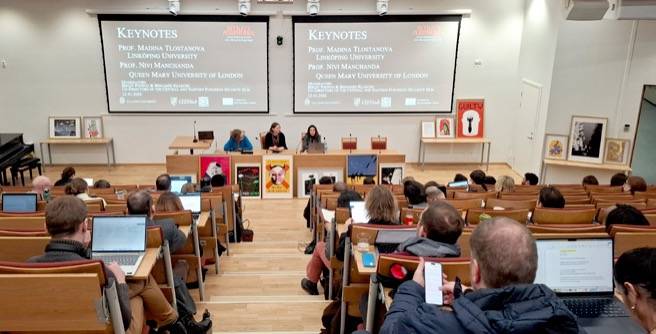
Back in January, we held our inaugural conference “Between Peripheries.” The conference featured an incredible array of thinkers, artists and scholars working at the intersection of post-colonial/de-colonial, critical and relational studies of IR. Now, our co-directors’, Dr. Birgit Poopuu and Dr. Benjamin Klasche conference report is out in #BalticWorlds. Go read it by following the link!
The conference highlighted the many ways we can and should build solidarities between the Global South and the Global East. Both regions have historically been affected by imperial and colonial processes and consequently share many of the historical memories and traumas that shape contemporary political processes. However, the conference also unveiled a set of conceptual, political and epistemological tensions between the Global South and the Global East. Both have experienced diverse forms of oppression in different ways. Global East occupies a more privileged position in global capitalist relations than Global South due to its closeness to the Global North.
This is also reflected in international politics where, as the report argues, there is an “absence of solidarity” across the two blocs. The report highlights that the West and the East cannot turn a blind eye to US imperialism and then ask for immediate solidarity from African states when they are in a position of need. Similarly, the report argues that romanticizing the Soviet Union and Russia to oppose US/Western imperialism is a step in the wrong direction. This obfuscates the racialization of Eastern Europeans by the imperialist gaze.
❓So, how can solidarities be built across this line of difference?
💡The first step is to center praxes of solidarity and contextual analyses of imperialism(s):
1️⃣ We must ask the right questions. Anna M. Agathangelou‘s point that we need to start converging around shared questions is a very important part of this conversation.
2️⃣ We must stand in solidarity. As the report states, “solidarity is difficult to emerge when it is expected only in one direction.” Here, Nivi Manchanda, in her keynote, has argued that the ‘privileged’ must exercise a ‘fugitive solidarity’ and refuse “the borders” that structure our lives while strategically using privilege to propel the oppressed.
3️⃣ Refuse arrogance. We hope that this will move us across the boundaries with the ethos of ‘non-arrogant perceptions,’ as Tlostanova Madina said in her keynote, quoting Maria Lugones’ work.
Between Peripheries, and CEEShub’s work more broadly, have had as their aim to propel the “value of thinking about resistance and solidarity” in their research. This report, and the January conference, are the first steps on this path.
Link to the report, published in #BalticWorlds:
Read it here!