
2026 has not been a hopeful year for nuclear disarmament and nonproliferation. The Israeli-US strikes on Iran starting on 28 February, after previous strikes in June 2025, are not only ineffective to prevent Iran from developing nuclear weapons, but raise the risk of nuclear proliferation and use. On March 2, French President Macron announced that France would increase its nuclear arsenal for the first time in over 35 years, and that it is in discussion with Belgium, Germany, Greece, Denmark, the Netherlands, Poland, Sweden and the United Kingdom about enhanced nuclear cooperation. Additional countries, including Lithuania, Latvia and Estonia have all expressed support for the idea. The Polish president suggested again in February that Poland should develop its own nuclear weapons.
This dark picture would cause some to throw up their hands and suggest that there is nothing to be done towards nuclear disarmament this year. That we simply must wait for more favorable security conditions to come about and in the meantime surrender to the inevitable arms race. But we can’t afford to be hopeless when there are still more than 12,000 nuclear weapons in the world today, and we know that the use of any one of those weapons would have catastrophic consequences. We cannot afford to be so naive as to believe that an academic theory called nuclear deterrence will keep us safe forever from these weapons of mass destruction.
Since ICAN’s founding in 2007, we have worked to reframe the discourse around nuclear weapons and highlight the evidence-based knowledge of the humanitarian consequences of nuclear weapons as the reason for prohibiting and eliminating them. Even if just one nuclear weapon of 100 kilotons were to be detonated over Tallinn today, the immediate health impact would be catastrophic. About 70,600 people could die immediately and another 130,000 could be injured, according to a projection on Alex Wellerstein’s NukeMap. Deterrence is based on the premise that it will never fail. But we know that it almost has, many times in the past, from the Cuban Missile Crisis to Able Archer, and it could have been only luck that prevented a humanitarian catastrophe.

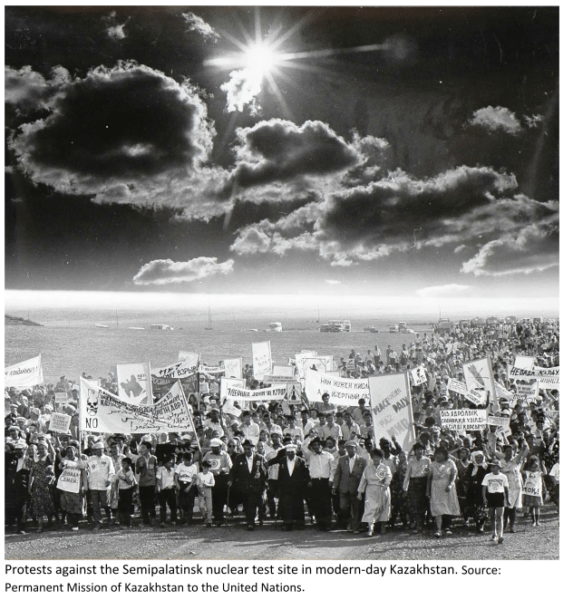
While there have always been those who argued that nuclear weapons were indispensable for their own security, others have achieved progress on nuclear disarmament in times of the highest tensions. During the Cold War, historians have argued that protestors in Europe were instrumental in bringing about the 1987 Intermediate Range Nuclear Forces Treaty. The Greenham Common Women’s Peace Camp, for example, brought hundreds of women to a permanent peace camp and thousands of protesters, over several years, to protest the UK’s decision to store U.S. nuclear missiles there. In Kazakhstan, the Nevada-Semipalatinsk Antinuclear Movement’s strong protests led to cancelled tests and the closure of the Semipalatinsk nuclear test site, at the time one of the Soviet Union’s major nuclear testing sites, after two million people signed a petition.
Most recently, ICAN, which today counts more than 700 partner organizations in more than 110 countries, worked with more than 120 governments to negotiate the first globally applicable treaty banning nuclear weapons. The Treaty on the Prohibition of Nuclear Weapons was adopted in July 2017 and entered into force in 2021. Prior to the treaty’s adoption, nuclear weapons were the only weapons of mass destruction not subject to a comprehensive ban. This treaty fills a significant gap in international law. It prohibits countries from engaging in any nuclear weapons activity.
Many European states have chosen to stay in the minority and have not yet joined this Treaty, despite popular opinion in support of doing so. We are working to bolster these democracies by more closely aligning government positions with the views of the electorate. Polls from 2018- 2021 show that majorities in nine European countries polled, from France to Germany to Italy to the Netherlands support their country joining the TPNW. Fifty-six former presidents, prime ministers, foreign ministers, and defence ministers from 20 NATO states, along with Japan and South Korea, released an open letter in September 2020 imploring current leaders to “show courage and boldness” and join the TPNW. They warned that the risks of nuclear weapons being used, “whether by accident, miscalculation, or design”, are increasing, and described the TPNW as “a beacon of hope in a time of darkness”

While some would argue that public opinion in Europe has shifted since Russia’s invasion of Ukraine, post-2022 polling data also confirms that current government policy in European nuclear-armed states is still out of step with the majority public opinion. In October 2024, people in France and the United Kingdom were asked in study conducted by the Sciences Po Nuclear Knowledges team and the institut francais d’opinion publique if “The risk of being victim of an accidental nuclear weapon explosion in the country where I live is acceptable if having nuclear weapons protects the country from attacks and invasions.” Only 6% of those polled in France and the United Kingdom said they strongly agreed while 19% and 15% said they somewhat agreed. Recent data from April 2025 YouGov polls also demonstrates the majorities of those polled in seven European states do not support hosting U.S. nuclear weapons, including in current nuclear host states Germany and Italy.

The TPNW gives a practical pathway for this public opinion to be channeled into political pressure. Over 500 cities, including Washington D.C, Paris, Manchester, Geneva, Canberra, Berlin, Oslo, Toronto and Zurich have publicly supported the treaty and urged their governments to join it. Over 1,400 sitting parliamentarians around the world have committed to work to get their government to join the treaty.
These are difficult times indeed. But we have no other choice than to work for nuclear disarmament. As long as nuclear weapons exist, they threaten life on earth as we know it. The world’s global majority is already on board the Treaty on the Prohibition of Nuclear Weapons, and we are confident that the rest of the world will join us on the right side of history.
Alicia Sanders-Zakre is the Head of Policy at the International Campaign to Abolish Nuclear Weapons. She directs the campaign’s research and policy development, including on the Treaty on the Prohibition of Nuclear Weapons and the humanitarian impact of nuclear weapons. Previously, she was a researcher at the Arms Control Association and at the Brookings Institution. She has published over one hundred articles, editorials and reports on nuclear weapons and provided expert analysis for several newspapers, radio and TV programs, including Al Jazeera, the Associated Press, the BBC, France24, and Reuters. Alicia holds a B.A. in International Security from Tufts University, a M.A.S in the International Law of Armed Conflict from the Geneva Academy of International Humanitarian Law and Human Rights.