A 2010 survey noted a consensus regarding international solidarity as a “prerequisite” for collaboration within the “international community” (Rizki, 2010). An otherwise commonsensical logic, deducible from the UN Charter itself, in cases like those of Palestine and Western Sahara, is apparently deemed controversial to turn into action. Yet, oppressed peoples insist on reminding the perhaps idealised “international community” evoked in UN declarations of its responsibilities.
While many seem perplexed at states and institutions’ inability or unwillingness to stop Israel’s genocide of Palestinians in Gaza, most are unaware of the brutal consequences of Morocco’s occupation and colonisation of Western Sahara. A critical and historicised account of foreign domination and the international system enabling it is needed to bring protracted conflicts to an end. Palestine and Western Sahara are prominent examples of how colonialism endures, having established solid roots and incorporating new forms of subjugation.
Along with other European imperial and colonial regimes imposed in Africa and South-West Asia (a.k.a., the Middle East), Spain claimed Western Sahara at the Berlin Conference in 1884. Britain occupied Palestine thirty years later in World War I, which the League of Nations turned into a Mandate (1922-1948). Each case is distinct, but the substitution of the European metropole for a regional or a new political entity is part of their constitution as settler-colonial systems that remain aligned with imperialist strategies.
Along with other European imperial and colonial regimes imposed in Africa and South-West Asia (a.k.a., the Middle East), Spain claimed Western Sahara at the Berlin Conference in 1884. Britain occupied Palestine thirty years later in World War I, which the League of Nations turned into a Mandate (1922-1948)
In Palestine, the British and the Zionist movement dispossessed, impoverished and disarmed the Palestinians, while developing what would become a Jewish state. Amidst rising conflict, the UN General Assembly adopted Resolution 181 endorsing the plan to partition Palestine into two states in 1947. Meanwhile, Zionist militias killed and expelled thousands of people, creating a refugee population amounting today to over 6 million people, and the State of Israel was established in 78% of Palestine in 1948, in an ongoing process of dispossession culminating in genocide named the Nakba – “Catastrophe” (e.g., Albanese, 2026; Said, 2003).
In Western Sahara, after the UN listed it as a Non-Self-Governing Territory in 1963, Spain tried but failed to manipulate the Saharawis’ political representation to determine the country’s fate and halted the decolonisation process, signing a secret Tripartite Agreement to transfer it to neighbouring Morocco and Mauritania in 1975. Morocco’s takeover then started through invasion and bombardment with napalm, resulting in the massacre, enforced disappearance and dispersion of part of the Saharawi population to Algeria, where over 170,000 refugees remain to-date, whereas Mauritania withdrew its claim in 1979 (e.g., Ojeda-García et al., 2017).
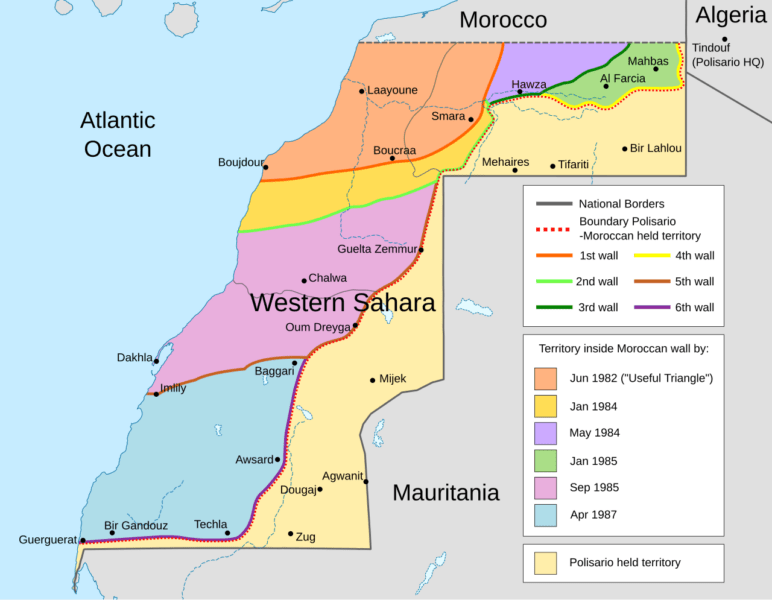
System of the Moroccan Walls in Western Sahara set up in the 1980s.
But Palestinians and Saharawis have long mobilised in associations, unions, and political parties, developing an anti-colonial national consciousness and raising international solidarity. Facing the colonisers’ repression, they organised into national liberation fronts – the Palestine Liberation Organisation (PLO) in 1964 and the Popular Front for the Liberation of Saguía el-Hamra y Río de Oro (Polisario) in 1973 – and launched armed struggles. Polisario then proclaimed the Saharawi Arab Democratic Republic as Spain left, in 1976 (Omar, 2008), whereas the proclamation of the State of Palestine marked the PLO’s strategic shift towards the two-state solution, in 1988 (e.g., Erakat, 2019).
Morocco’s takeover then started through invasion and bombardment with napalm, resulting in the massacre, enforced disappearance and dispersion of part of the Saharawi population to Algeria, where over 170,000 refugees remain to-date, whereas Mauritania withdrew its claim in 1979
When people resist, colonisation can only be implemented through systematic repression (Fanon, 2001). Therefore, Israel and Morocco established a prolonged military occupation to structure territorial and demographic control and used similar methods, such as the construction of physical barriers. This way, Israel and Morocco enable the settlement of foreign population, the exploitation of resources and the commercialisation of products in global markets. Capitalist accumulation is hence secured not only there, but also in the USA, Europe, and beyond. Colonialism is thus part of business (see, e.g., ‘Amel, 2022).
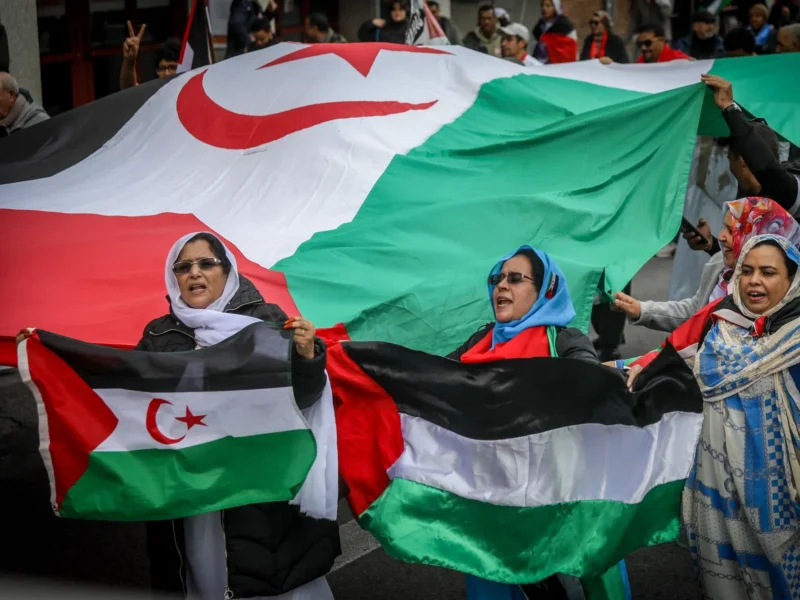
A group of Sahrawi-Moroccan women protest in November in favor of Palestine in Madrid. David Canales/SOPA/ZUMA
Meanwhile, framing these plights as “intractable conflicts”, turning a right into a negotiable matter, and forcing “concessions” on the occupied in protracted diplomatic processes, “mediators” such as the USA or the European Union (EU) take the occupiers’ side, instead of exercising their duty of supporting the realisation of self-determination (e.g., Erakat, 2019; Omar, 2008).
Despite modest condemnations and occasional sanctions against “extremist settlers”, who are then individualised instead of understood as part of a broader oppressive system, the EU, like the USA and the UK, professes unwavering support to Israel, including by providing it with the means, in addition to political clout. In Morocco’s case, Spain, France, the US and the EU have endorsed its solution for Western Sahara, which amounts to annexing the territory and the people under an obscure autonomous status, again trampling the people’s will for independence.
The connection between these plights thus brings deep contradictions to the fore. World powers have overturned the desideratum for self-determination in Palestine and Western Sahara to secure their strategic interests. Today, these regions seem farther than ever from the peace and security they claim to promote. Still, Saharawis and Palestinians consistently assert that their liberation is a condition for global justice, internationalising their struggle by foregrounding international responsibility.
This way, Israel and Morocco enable the settlement of foreign population, the exploitation of resources and the commercialisation of products in global markets. Capitalist accumulation is hence secured not only there, but also in the USA, Europe, and beyond. Colonialism is thus part of business
Denouncing complicity or neglect, Palestinian, Israeli, and other scholars expose the coloniality behind the dehumanisation of Palestinians in discourse and policy, including by those supposed to act to stop the ongoing genocide (e.g., Albanese, 2026; Oleart et al., 2026). Conversely, US, European, and Global South scholars investigate their Governments, Universities, and other institutions’ part in the global injustice system, and in how violence exercised over Palestinians reverts into war or oppression of marginalised communities elsewhere (e.g, Agha et al., 2025; Alqaisiya and Perugini, 2024; Al-Shabaka, 2025; Sa’di and Masalha, 2023).
In turn, Saharawis and other scholars and activists insist that Western Sahara is a question of decolonisation, rejecting Morocco’s and its allies’ attempts at distorting it into an internal or regional conflict. Facing imprisonment and torture for mobilising and reporting from under occupation (e.g., Lakemfa, 2024, UN Committee against Torture, 2026), some turn to international networks and organisations, or host Parliamentarians, scholars and other delegations to show them their reality and determination. Having observed a cease-fire from 1991 until 2020, the Polisario Front has repeatedly called for the promised referendum and accountability by engaging the UN or states bilaterally, and challenges commercial agreements between the EU and Morocco involving Western Sahara’s resources before the EU Court of Justice, for instance (SPS, 2026).
This is thus a multi-pronged strategy aimed at achieving national liberation by engaging an “international community” grounded in respect for equality and self-determination. Scholars are obviously part of this “community”, as are other political actors obliged to defend peoples’ rights. Acting upon this responsibility is what will lead us beyond merely reiterating yet another abstract concept to the effective practice of international solidarity.
* This publication is based upon work from COST Action PEACE (CA23129), supported by COST (European Cooperation in Science and Technology).
COST (European Cooperation in Science and Technology) is a funding agency for research and innovation networks. Our Actions help connect research initiatives across Europe and enable scientists to grow their ideas by sharing them with their peers. This boosts their research, career and innovation.

Dr Moara Assiss Crivelente is a post-doctoral researcher at the Centre for Social Studies (CES) of the University of Coimbra, Portugal.